

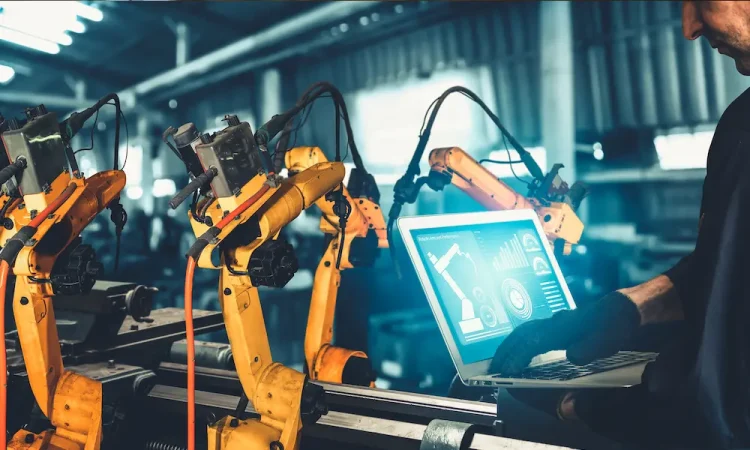
Machine tending refers to the automated loading and unloading of production machines using robots, most increasingly collaborative robots. It occupies a central position in modern manufacturing because it targets tasks that are repetitive, time-consuming, and physically demanding, yet essential for keeping machines productive. In many factories, machines themselves are highly capable, but their utilization is limited by manual handling activities that add no direct value to the product. Machine tending addresses this gap by ensuring that equipment runs consistently, with minimal interruption, regardless of shift patterns or labor availability. For production managers and decision-makers, machine tending is often one of the most accessible and impactful automation use cases.
From an operational perspective, machine tending acts as a bridge between manual labor and fully automated production lines. It does not require a complete redesign of the manufacturing process, which makes it particularly attractive for small and medium-sized enterprises. Instead, it enhances existing assets by stabilizing the flow of parts into and out of machines. This incremental approach allows companies to improve productivity and predictability while maintaining flexibility. As a result, machine tending has become a cornerstone of pragmatic automation strategies across many industries.
Common Machine Types in Machine Tending Applications
CNC machines are among the most frequently automated through machine tending. Operators traditionally spend a significant portion of their time opening doors, loading raw parts, unloading finished components, and restarting cycles. These tasks are repetitive and limit spindle utilization, especially during breaks or shift changes. By assigning these activities to a robot, CNC machines can operate more continuously, improving overall throughput and reducing idle time. Consistent handling also helps maintain stable part positioning, which supports machining quality.
Injection molding machines present a different but equally compelling case for automation. Molded parts are often ejected automatically, but manual removal, inspection, and stacking still consume operator time and introduce variability. Robots can extract parts immediately after ejection, reducing cycle interruptions and minimizing the risk of deformation while the part is still warm. In addition, automation helps manage high cycle rates that are difficult for humans to sustain over long periods without fatigue.
Presses, including stamping and forming presses, are another common target for machine tending. Manual loading and unloading of presses exposes operators to safety risks and requires strict procedural discipline. Robots can perform these tasks with consistent timing, reducing exposure to moving tooling and enabling more stable production rhythms. Grinders also benefit from automation, particularly where parts require frequent loading and unloading for finishing operations. In these environments, machine tending improves both safety and process repeatability.
Manual Tasks That Benefit from Automation
Many manual activities around machines are ideal candidates for automation because they combine low cognitive demand with high physical repetition. Opening and closing machine doors, placing parts into fixtures, removing finished components, and clearing chips or scrap all fall into this category. These tasks often contribute little to product value but consume a disproportionate amount of operator time. Automating them allows skilled workers to focus on setup, quality control, and process optimization instead.
Automation also reduces variability introduced by human fatigue or differences in handling technique. In manual tending, slight inconsistencies in part placement or timing can lead to quality issues or machine alarms. Robots perform the same motion in the same way every cycle, which stabilizes the process. Over time, this consistency translates into fewer disruptions, less rework, and more predictable production planning.
Key Performance Indicators in Machine Tending
The effectiveness of machine tending is typically measured through a set of key performance indicators that reflect both machine and system-level performance. Uptime is one of the most important metrics, as it indicates how much of the available time a machine is actually producing parts. Manual tending often limits uptime due to breaks, shift changes, or delays in part handling. Automated tending reduces these gaps and keeps machines running closer to their theoretical capacity.
Cycle time is another critical indicator. While the machining or forming operation itself may be fixed, handling time can vary significantly when performed manually. Robots execute loading and unloading motions with consistent timing, reducing variability and supporting tighter cycle control. Utilization ties these metrics together by showing how effectively expensive equipment is used over time. Higher utilization improves return on investment and justifies further automation initiatives.
End-of-Arm Tooling Strategies for Loading and Unloading
End-of-arm tooling plays a decisive role in successful machine tending. The choice of gripper determines how reliably parts can be picked, oriented, and placed into machines. Mechanical grippers are commonly used for rigid components that require precise positioning, particularly in CNC applications. Vacuum grippers are well suited for flat or thin parts, such as molded components, while magnetic grippers are effective for handling ferromagnetic materials in press operations.
Beyond the gripping principle itself, tooling strategies often include features that support alignment and error tolerance. Compliance, chamfers, and controlled insertion motions help accommodate minor variations in part position or machine condition. Well-designed tooling reduces the likelihood of jams and misloads, which are among the most common causes of downtime in machine tending cells. As a result, EOAT selection is closely linked to long-term reliability and maintenance effort.
Safety and Human-Robot Interaction
Safety is a central consideration in machine tending, especially when collaborative robots are used. While cobots are designed to operate safely around people, the machines they tend may involve hazards such as moving tooling, sharp edges, or high temperatures. Effective safety design requires coordination between robot behavior, machine safeguards, and operator access. Interlocks, safe zones, and clearly defined operating modes help ensure that automation enhances safety rather than introducing new risks.
Human-robot interaction is also shaped by predictability. Robots that move in a consistent and understandable manner are easier for operators to work alongside. Clear visual cues, defined handover points, and stable motion paths support intuitive cooperation. When these elements are designed thoughtfully, machine tending cells can improve both safety and operator acceptance, which is critical for long-term success.
Trends in Adaptive and Intelligent Machine Tending
Machine tending is evolving beyond simple load-unload automation toward more adaptive and intelligent systems. Advances in sensing, force control, and software integration allow robots to respond to variations in part condition or machine behavior. Adaptive insertion strategies, for example, enable robots to adjust motion based on real-time feedback, reducing scrap and improving robustness. Integration with production data systems further enhances visibility into performance and downtime causes.
These developments are expanding the scope of machine tending automation from a productivity tool into a foundation for resilient, data-driven manufacturing. As machines become more connected and flexible, machine tending systems increasingly contribute to adaptive machining strategies that balance efficiency with responsiveness. For modern production environments facing rising complexity and labor constraints, this evolution underscores why machine tending continues to matter as a strategic element of automation.